Core French vs. Immersion: What Waterloo Region Parents Are Actually Choosing Between
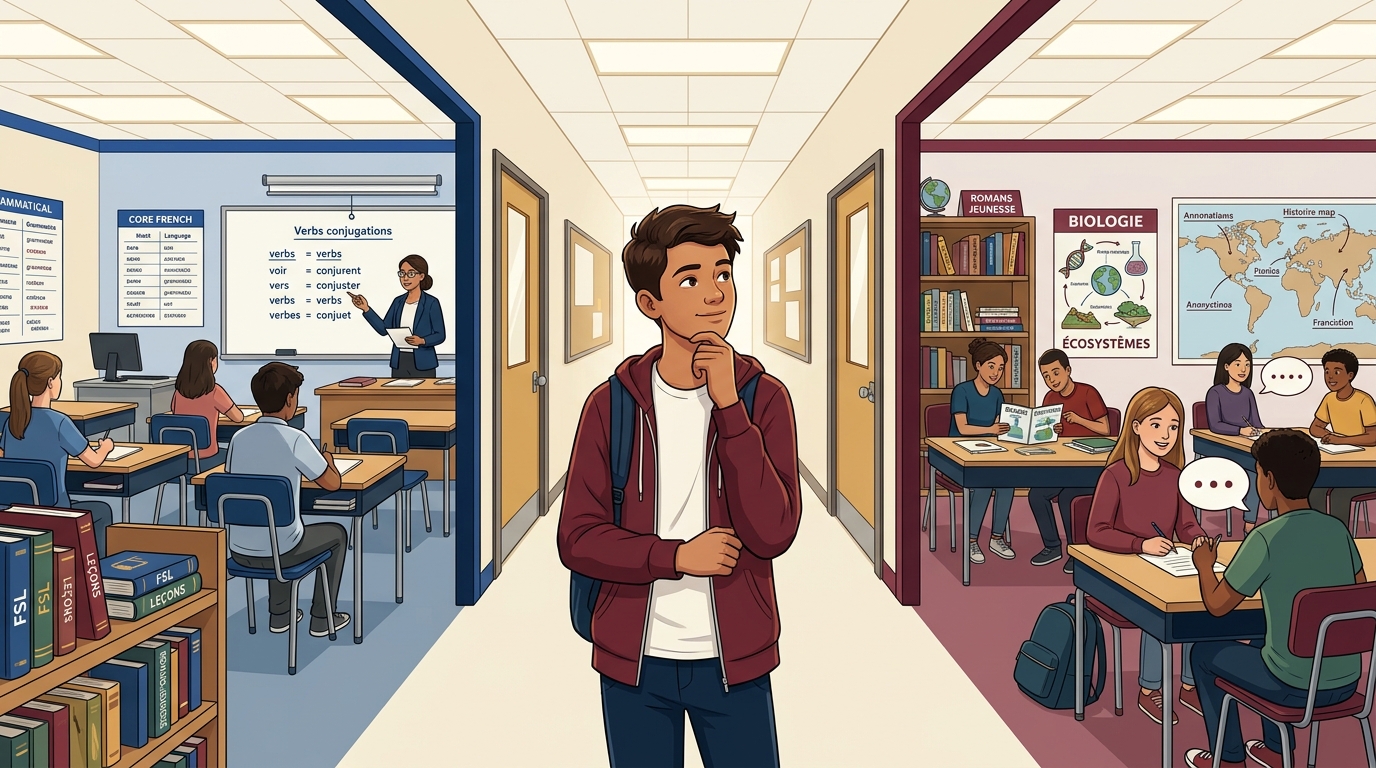
If you're a Waterloo Region parent trying to figure out French for your child, you've probably run into two terms that sound similar but describe genuinely different programs: Core French and French Immersion. Picking between them — or supporting a child already enrolled in one — gets a lot easier once you understand what actually separates them.
Two different programs, not two difficulty levels
It's tempting to think of Immersion as just "the harder version" of Core French, but that's not quite right. Core French is a mandatory subject from Grades 4 through 8, taught as one course among many, and becomes an elective after that. French Immersion is a completely separate enrollment track — one families typically opt into as early as JK or SK — where a student takes other subjects in French, not just a French-language class. They're different commitments with different starting points, not two speeds of the same road.
The course codes behind each path
Once Core French becomes an elective, it runs through the FSF1D to FSF4U course sequence in high school. Immersion students follow a different track, typically coded FIF or FEF depending on the school board and course. If you're trying to map out your child's path a few years ahead, knowing which sequence they're actually on — not just "French class" in general — makes it much easier to plan for what's coming.
You don't need to speak French to support Immersion
Here's the misconception that stops a lot of parents from getting involved: you do not need to speak French yourself to support a child in French Immersion. Most Immersion families in Waterloo Region don't speak French at home, and that's the norm, not the exception. Your role doesn't change from what it would be in any other subject — checking in, reviewing feedback, celebrating progress. The same is true for families supporting a Core French student, which is where our own tutoring program focuses.
The Ontario Bilingual Certificate: a concrete goal
For families thinking long-term, Ontario's Bilingual Certificate gives French study a real, checkable finish line rather than a vague "become bilingual" aspiration. It's a graduation credential: 7 French credits for the Extended French / Honours-track path, or 10 credits for the French Immersion path. Knowing which credit count applies to your child — and tracking progress against it year over year — turns a long program into a series of concrete, gradable milestones.
What about DELF/DALF?
For families aiming at a formal French proficiency credential beyond high school — useful for certain university programs, employment, or immigration purposes — DELF and DALF are the internationally recognized exams. One practical wrinkle for anyone in Kitchener-Waterloo: there's no Alliance Française chapter in this region, so the exam itself has to be written at an approved centre in the Toronto area. That doesn't mean local prep isn't possible — it just means the preparation and the exam sitting happen in two different places, and it's worth building that logistics gap into your timeline early rather than discovering it a month before test day.
Choosing — or supporting — the right path
Whether your child is already deep into one track or you're still deciding between them, the questions that matter are the same: what course code are they actually on, what credential (if any) are they working toward, and where are the specific gaps showing up. A generic "French help" session is a lot less useful than one built around your child's actual track, grade, and course code — that's the difference between reviewing vocabulary in the abstract and reinforcing exactly what their FSF or FIF class covered this week.
One note on scope: KW Education's tutoring program is currently built around Core French specifically. If your child is in Immersion, this article is still a useful primer on how the two paths differ — and we're happy to talk through whether we're the right fit for your family.


Ready to See This Work for Your Child?
Take our 30-second quiz — no commitment, just a quick way to find the right fit.