OSSLT, IELTS or AP? A Parent's Guide to Ontario's Big Exams

Among the OSSLT, AP exams, and IELTS, it's easy for the acronyms to blur together into one big vague category of "exams we need to worry about eventually." They're actually solving three very different problems, with three different timelines, and mixing them up can mean prepping for the wrong thing at the wrong time.
OSSLT: the graduation requirement
The Ontario Secondary School Literacy Test is a graduation requirement tied to Grade 10 literacy expectations — every Ontario student generally needs to pass it (or complete the equivalent course) to graduate. It's not an admissions tool and it's not designed to differentiate strong students from average ones; it's a pass/fail literacy checkpoint. For most students, this is a matter of building solid, unglamorous reading-and-writing fundamentals well before Grade 10, not a last-minute cram. If your child is a confident reader and writer, the OSSLT usually isn't the thing to lose sleep over — but it's worth confirming that, rather than assuming it.
AP: the admission-average booster
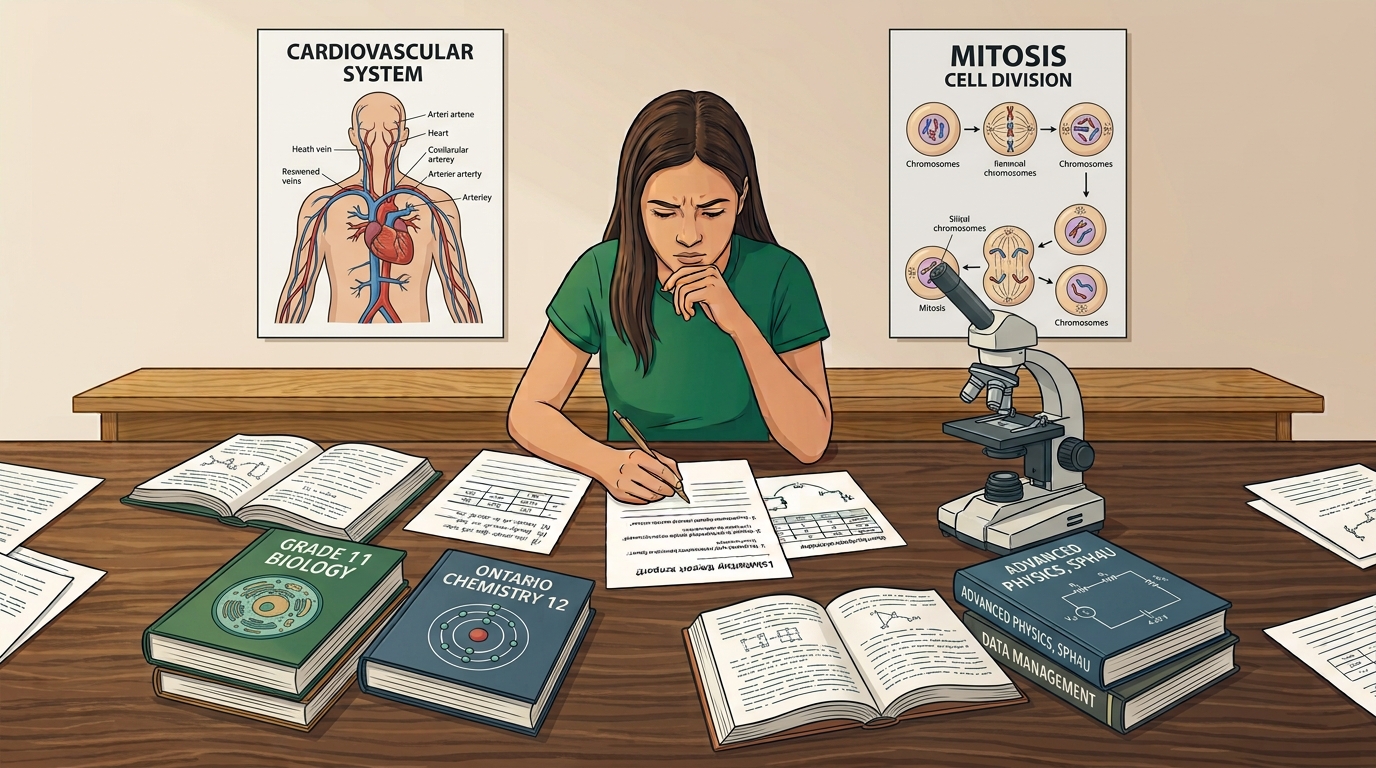
Advanced Placement courses are a different animal entirely — optional, university-level courses (AP Calculus, AP Biology, AP Chemistry, AP Physics, and others) that Ontario students can take alongside their regular course load. AP isn't a graduation requirement or an immigration document — it's a way to demonstrate advanced achievement in specific subjects and, at some universities, earn admission consideration, course placement, or university credit. The stakes here are about strengthening an admission average and standing out for competitive programs, and the exam itself sits at the end of a full course, not a short prep window.
IELTS: the exam with real-world stakes
IELTS (the International English Language Testing System) is a different category again — a proficiency exam that matters for university admission, professional licensing, and immigration applications — most relevant for international and adult learners rather than a typical Ontario high schooler. It's scored on a band scale, and the practical goal isn't "do well" in the abstract — it's hitting the specific band score a particular university, employer, or immigration application actually requires. A student aiming for a band 7+ for a competitive program needs meaningfully different prep than someone who needs a band 5.5 to meet a baseline requirement, which is why "IELTS prep" without a target band attached isn't really a plan yet.
One more thing: Ontario's returning final exams
There's a fourth piece worth knowing about even though it's not a standalone exam name: starting in the 2026-27 school year, Ontario is reintroducing mandatory final exams weighted at 20% of the final grade in Grades 9-10, and 25% in Grades 11-12. For students who haven't experienced a heavily-weighted final exam before, that's a real shift in how much a single exam day can move a final mark — and it's worth factoring into any exam-prep plan alongside OSSLT, AP, or IELTS specifically.
Building a plan instead of panicking
The biggest mistake parents make with this list isn't under-preparing for any one exam — it's treating all of them as one undifferentiated "exam season" instead of separate goals on separate timelines. The OSSLT calls for solid literacy fundamentals well ahead of Grade 10. AP calls for sustained, course-length preparation tied to a specific subject. IELTS calls for a target band score and a timeline tied to an actual application deadline. Once you know which exam you're actually planning for, and why, it stops being one big blur of acronyms and starts being a manageable checklist.

Ready to See This Work for Your Child?
Take our 30-second quiz — no commitment, just a quick way to find the right fit.