The Grade 11-to-12 Science Jump: Why Strong Students Suddenly Struggle
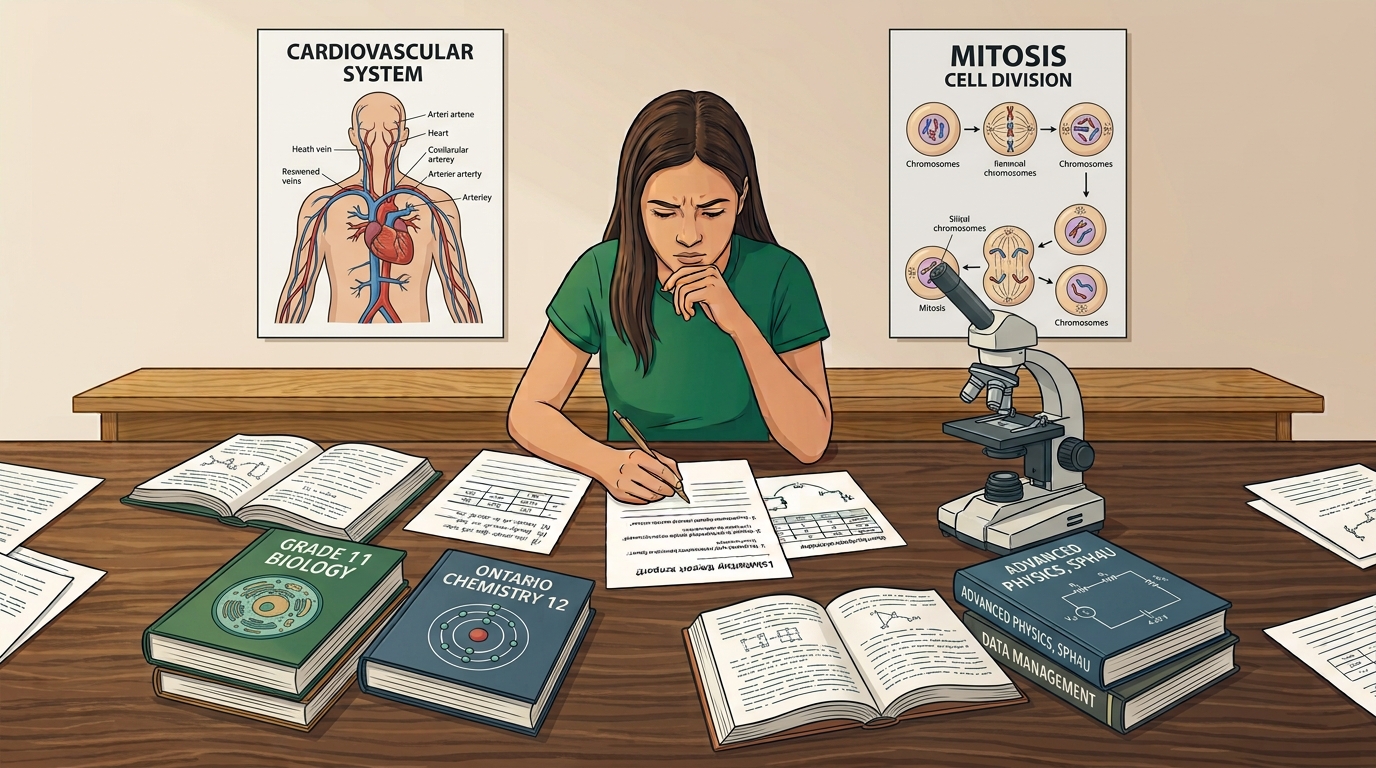
Every year, a familiar story shows up in Ontario science classrooms: a student who did genuinely well in Grade 11 chemistry, biology, or physics hits Grade 12 and suddenly finds themselves working twice as hard for the same grade — or a lower one. It's disorienting for the student and often confusing for parents, because nothing about the child changed. What changed is the course.
It's not that your child got worse at science
The instinct is to assume something's wrong — a motivation problem, a study-habits problem, a "they got lazy" problem. Usually none of that is true. Grade 12 university-level science courses like SPH4U (Physics), SCH4U (Chemistry), and SBI4U (Biology) are structured differently from their Grade 11 counterparts, and that structural jump is a real, well-documented pattern, not a character flaw.
What SPH4U, SCH4U, and SBI4U actually demand
These senior courses move faster and lean much more heavily on independent problem-solving than Grade 11 does. Where Grade 11 science often still walks students through a process step by step, Grade 12 expects students to apply concepts to unfamiliar problems on their own — closer to how the material will actually be used at university. That's exactly the kind of jump that catches strong, previously "easy A" students off guard, because the skills that made Grade 11 comfortable — memorization, following a template — aren't enough anymore.
The lab report problem nobody warns you about
Here's a detail that surprises a lot of parents: lab reports carry real weight in senior science, worth roughly 20-30% of a physics grade in some courses. That's not a rounding error — it's often the single biggest category outside of tests and exams. And lab reports test a completely different skill than a multiple-choice unit test: designing a method, analyzing data honestly, and drawing a defensible conclusion. A student can understand the underlying chemistry or physics perfectly and still lose significant marks because nobody ever explicitly taught them how to write a strong lab report. That's a teachable skill, not an innate one — but it does need to be taught directly, not assumed.
Why this matters for university admission averages
Grade 11 and 12 science courses are almost always part of a university's admission average calculation — for many programs, they're squarely in the mix of courses that matter most. A senior science course that drags the average down doesn't just sting on a single report card; it can shape which programs are realistically in reach. That's part of why catching a Grade 12 science slide early matters more than it might for an elective.
Catching the gap before report card day
The good news is that the Grade 11-to-12 jump is predictable, which means it's also plannable for. If your child is heading into SPH4U, SCH4U, SBI4U, or the AP/IB equivalents, the smartest time to get support in place is before the first major lab report or unit test, not after a disappointing one comes home. The goal isn't teaching new content your child's teacher hasn't covered yet — it's translating what's already been taught, and directly building the lab-report and independent problem-solving skills the course now expects, before those gaps show up as a grade.


Ready to See This Work for Your Child?
Take our 30-second quiz — no commitment, just a quick way to find the right fit.